A dental filling can repair many cavities and areas of minor tooth damage, but sometimes a tooth has lost too much structure for another filling to provide adequate support. In these situations, a dentist may recommend a dental crown.
A crown—sometimes called a “cap”—covers the visible portion of a tooth. It is designed to restore the tooth’s shape and function while helping protect weakened tooth structure.
According to the American Dental Association’s guide to dental crowns, crowns may be used to strengthen teeth with large fillings, protect weak teeth from breaking, restore teeth that are already broken, improve the appearance of certain teeth, support dental bridges, and cover dental implants. MouthHealthy
For patients considering dental crowns in Anaheim, understanding why a crown is recommended can make it easier to compare it with other restorative options.
What Is a Dental Crown?
A dental crown is a restoration that covers a prepared natural tooth.
Unlike a filling, which replaces a portion of missing tooth structure, a crown generally covers most or all of the visible part of the tooth above the gumline.
Crowns can be made from different dental materials, and the appropriate material may depend on the tooth’s location, appearance, bite forces, remaining tooth structure, and other clinical considerations.
The goal is to create a restoration that allows the tooth to function appropriately while protecting the remaining structure.
Why Would a Dentist Recommend a Crown Instead of a Filling?
The decision often comes down to how much healthy tooth remains and how much support the tooth needs.
A filling works well when there is enough surrounding tooth structure to hold and support the restoration.
If a tooth contains a very large filling, has lost substantial structure from decay, or has fractured, simply placing another filling may not provide adequate protection.
The ADA notes that a crown can help strengthen a tooth containing a large filling when there is not enough remaining tooth structure to adequately hold the filling. MouthHealthy
A crown distributes biting forces over the restored tooth differently from a large filling.
Can a Cracked Tooth Need a Crown?
Yes, depending on the type and extent of the crack.
Teeth can crack because of:
- Biting hard foods or objects
- Dental trauma
- Large existing fillings
- Tooth grinding or clenching
- General wear over time
Some minor chips can be treated with bonding or another conservative restoration.
A more substantial crack may require a crown to surround and protect the remaining tooth.
However, not every cracked tooth can be treated with a crown. If a fracture extends deeply into the root or compromises the tooth significantly, other treatment may be necessary.
An examination is needed to determine the location and extent of the damage.
Does a Large Filling Mean You Need a Crown?
Not automatically.
Many large fillings continue functioning successfully.
The dentist considers several factors, including:
- Amount of natural tooth remaining
- Condition of the existing filling
- Presence of cracks
- Location of the tooth
- Bite forces
- Previous dental treatment
- Symptoms
- Evidence of new decay
Age alone is not necessarily a reason to replace a filling with a crown.
If an older filling remains intact and the surrounding tooth is healthy, monitoring may be appropriate.
Can a Broken Tooth Be Repaired With a Crown?
Sometimes.
The ADA identifies restoring an already broken tooth as one of the uses for a dental crown. MouthHealthy
Whether this is possible depends on how much healthy tooth remains.
If only part of the visible tooth has fractured and sufficient sound structure remains, the dentist may be able to rebuild and cover the tooth with a crown.
More extensive fractures require careful evaluation because the tooth must have enough healthy and supported structure to hold the final restoration predictably.
Why Are Crowns Common After Root Canal Treatment?
Root canal treatment addresses inflamed or infected tissue inside a tooth, but it does not replace tooth structure lost to cavities, fractures, or previous restorations.
The ADA explains that after root canal treatment, a tooth may receive a permanent filling or crown to protect it from further damage. MouthHealthy
Back teeth in particular experience substantial chewing forces and may require greater structural protection after root canal treatment.
The final restoration depends on the tooth’s location and how much healthy structure remains.
Not every root canal-treated tooth automatically receives exactly the same type of restoration.
Can a Crown Fix a Cosmetic Problem?
Crowns can improve appearance as well as function.
The ADA notes that crowns can cover teeth that are discolored or badly shaped. MouthHealthy
However, a crown may not be the most conservative choice when a tooth is healthy and the concern is entirely cosmetic.
Depending on the situation, alternatives might include:
- Professional teeth whitening
- Dental bonding
- Porcelain veneers
- Orthodontic treatment
A cosmetic consultation can help determine whether the tooth actually needs full coverage or whether a more conservative option can achieve the desired change.
Are Crowns Used With Dental Implants?
Yes.
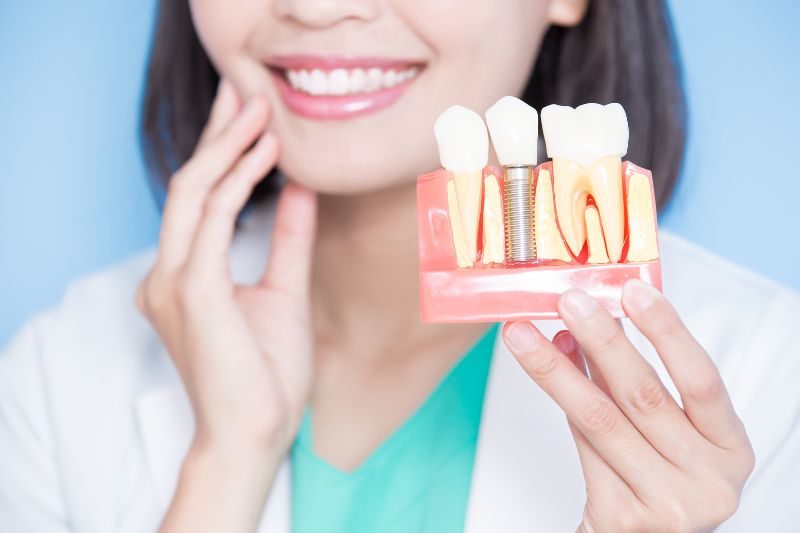
A dental implant replaces the root portion of a missing tooth, while an implant crown can replace the visible tooth.
This is different from placing a crown over a natural tooth.
With a natural tooth, the crown fits over prepared tooth structure. With an implant, the crown connects to the implant restoration.
The ADA identifies covering a dental implant as another established use of dental crowns. MouthHealthy
Are Crowns Used to Support Dental Bridges?
They can be.
A traditional dental bridge replaces a missing tooth by obtaining support from teeth adjacent to the space.
Crowns placed over those supporting teeth can form part of the bridge.
This creates a fixed restoration rather than a removable appliance.
The condition of the supporting teeth is important because they must be able to support the bridge over time.
What Happens Before Getting a Dental Crown?
The process starts with an examination.
Your dentist evaluates the tooth and may recommend dental X-rays when additional information is needed about the roots, surrounding bone, existing restorations, or other structures.
The ADA recommends that dental X-rays be taken according to individual diagnostic need rather than automatically at every appointment. MouthHealthy
If the tooth has decay, damaged restorative material, or weakened structure, those issues need to be addressed as part of preparing the tooth.
What Happens During Crown Preparation?
Local anesthesia is generally used so the treatment area remains comfortable.
The dentist prepares the tooth by removing damaged material as needed and shaping the remaining tooth so the crown can fit over it.
If substantial tooth structure has already been lost, restorative material may first be used to rebuild the tooth.
An impression or digital scan is then used to record the prepared tooth and surrounding bite.
This information helps create a crown that fits appropriately with neighboring and opposing teeth.
Will You Have a Temporary Crown?
Traditional crown treatment commonly involves a temporary restoration while the final crown is being made.
The temporary crown helps protect the prepared tooth and maintain appearance and function between appointments.
Because temporary cement is designed differently from the material used for the final restoration, patients may receive instructions to avoid particularly sticky or hard foods around the temporary crown.
If a temporary crown becomes loose or comes off, contact the dental office rather than trying to permanently glue it back yourself.
What Happens When the Final Crown Is Placed?
At the placement appointment, the temporary restoration is removed and the final crown is evaluated.
The dentist checks factors such as:
- Fit
- Contact with neighboring teeth
- Bite
- Shape
- Appearance when relevant
Adjustments can be made when necessary.
Once the dentist and patient are satisfied with the fit and appropriate clinical requirements are met, the crown is cemented or otherwise secured in place.
Does Getting a Crown Hurt?
Local anesthesia is typically used during tooth preparation.
After the appointment, the tooth or surrounding gum tissue may feel temporarily sensitive.
Sensitivity does not necessarily mean something is wrong, particularly shortly after treatment.
Contact your dentist if you develop significant or worsening pain, persistent difficulty biting, swelling, or other symptoms that concern you.
Sometimes a new crown simply needs a bite adjustment, while other symptoms may require further evaluation.
Why Does My New Crown Feel High When I Bite?
A new restoration needs to fit correctly within your bite.
If a crown contacts the opposing tooth too heavily, you may notice that it seems to touch before your other teeth.
Do not assume you simply have to become accustomed to significant bite discomfort.
Contact your dentist.
A small adjustment may be enough to improve the way the teeth come together.
Can a Tooth Under a Crown Still Get a Cavity?
Yes.
A crown covers the tooth, but the underlying tooth structure is still natural.
The area where the crown meets the tooth remains important to keep clean.
Plaque accumulation around this margin can contribute to tooth decay and gum inflammation.
A crowned tooth therefore still needs routine brushing, interdental cleaning, and dental examinations.
A crown does not make the underlying tooth immune to future dental disease.
How Do You Clean Around a Dental Crown?
Treat a crowned tooth as part of your regular oral hygiene routine.
Brush twice daily with fluoride toothpaste and clean between the crowned tooth and neighboring teeth every day.
Pay particular attention to the crown margin near the gumline.
If the crown is part of a dental bridge, additional cleaning methods may be necessary underneath the replacement tooth.
Your dental team can demonstrate appropriate floss, floss threaders, interdental brushes, or other tools for your specific restoration.
How Long Does a Dental Crown Last?
There is no exact lifespan that applies to every crown.
Longevity can be influenced by:
- Oral hygiene
- Tooth position
- Bite forces
- Tooth grinding or clenching
- Crown material
- Condition of the underlying tooth
- Diet and habits
- Dental trauma
Even a well-maintained crown may eventually require repair or replacement.
Regular examinations allow the dentist to monitor both the restoration and the tooth supporting it.
Can Grinding Damage a Crown?
Heavy grinding and clenching can place additional stress on natural teeth and dental restorations.
Patients who grind their teeth may experience:
- Tooth wear
- Chipped restorations
- Crown damage
- Jaw muscle discomfort
- Morning headaches
If you grind or clench, tell your dentist.
Depending on the cause and your oral condition, a protective appliance or another approach may be discussed.
What Should You Do if a Crown Comes Off?
Keep the crown if you can find it and contact your dental office.
Avoid using household glue to attach it.
The dentist needs to determine why it came off and examine the underlying tooth.
In some cases, an intact crown can be recemented. In others, the crown or tooth may require additional treatment.
Until the area is evaluated, avoid chewing hard foods on the affected tooth, particularly if it feels sensitive or fragile.
Crown or Filling: How Does a Dentist Decide?
There is no universal rule based solely on the size of a cavity.
The dentist evaluates the complete tooth, including:
- Remaining natural structure
- Existing restorations
- Cracks or fractures
- Amount of decay
- Bite forces
- Tooth position
- Pulp health
- Long-term restorability
A smaller restoration is generally preferable when it can predictably restore the tooth.
A crown becomes more relevant when the tooth needs broader structural coverage and protection.
Dental Crowns in Anaheim, CA
Dental Aesthetics Professionals provides restorative dental care for patients with cracked, broken, weakened, heavily restored, or otherwise damaged teeth in Anaheim.
If you have been told that you may need a crown—or an older filling has started to feel different—an examination can determine how much healthy tooth remains and whether a crown, filling, or another treatment is appropriate. A crown recommendation should be based on the condition of the individual tooth rather than automatically replacing every large or older filling.
Learn more about dental crowns and restorative dentistry at Dental Aesthetics Professionals or call 714-772-3538 to schedule an evaluation.